Qualified Charitable Distributions: Retire Like a Pro
Written by Sarah York
Published August 26th, 2025
Retirement is for doing what you love –not stressing over taxes. Luckily, there’s a way to turn your required minimum distribution into a feel-good moment: Giving to your favorite charity while trimming down your taxable income.
Let’s break down how it works, when it makes sense, and how to do it.
What is a Qualified Charitable Distribution?
A Qualified Charitable Distribution (QCD) is a gift made directly from your IRA to a charity. When a gift is set up in this fashion, it counts toward your required minimum distribution (RMD), but the withdrawn amount isn't taxable to you. (More on this later) Eligible taxpayers can give up to $108,000 per year. If you’re married and both spouses have IRAs, you can each do this for a combined $216,000 per year.
How Does a QCD Save Me Money?
A QCD can save you money in several ways:
Higher overall deductions
Normally, charitable giving is included in your itemized deductions, which directly compete with your standard deduction — write off whichever is higher. With a QCD, your gift is deducted directly from your taxable income, meaning the deduction is stacked on top of your standard deduction instead of competing with it.
Let’s look at an example:
Meet Carol and Mike. They are both 75 and their joint income is $100,000, which includes $20,000 in RMDs from their traditional IRAs. By switching to the QCD strategy, they will be able to lower their tax bill by $1,000.
Without a QCD:
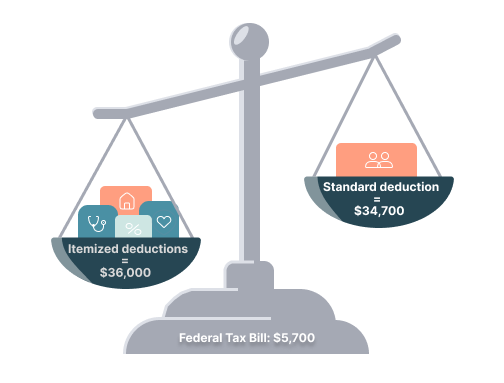
Carol and Mike give $10,000 to their favorite charity every year. When combined with their medical costs, property taxes, and mortgage interest, their total itemized deductions are $36,000. Their annual tax bill is roughly $5,700.
With a QCD:
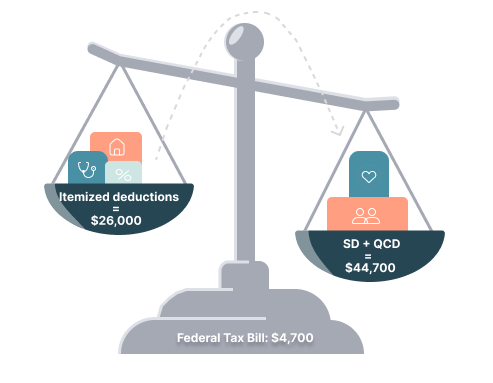
If Carol and Mike donate the $10,000 directly from their IRA instead, their joint income would be $90,000 ($100,000 - $10,000 QCD). They don't have enough to itemize, so they take the standard deduction. Their annual federal tax bill is now $4,700.
More favorable tax brackets
Not only can this approach keep you safe from higher tax brackets, but for some lucky people, it can shield all, or most, of their Social Security from tax.
Under current law, tax on Social Security income is phased in according to your income. Once your earnings exceed certain thresholds, up to 85% of your Social Security income can be subject to tax.
Itemized deductions don’t affect this formula, but QCDs do. For retirees with low income, this is a great workaround to consider.
When Does a QCD Make Sense?
This strategy won’t work for everyone. Here are the key guidelines to consider:
- You’re 70½ or older. You must be at least 70½ on the date of the distribution.
- You have a traditional IRA. QCDs must come from an IRA (not a 401(k) or other plan, unless you roll those funds into an IRA first). This won’t work for a pension.
- You want to give to charity. Tax strategies should always align with your goals: Don’t donate for the sake of tax savings.
- You choose an eligible charity. The charity must be a qualified 501(c)(3) organization (not a donor-advised fund or private foundation).
- Your itemized deductions are modest. If your itemized deductions far exceed your standard deduction, this strategy will have little to no value.
How do I Set Up a QCD?
You’ve thought it all through and you’re ready to take the plunge – great! Here are the steps to make this work:
- Contact your IRA custodian. Tell them you want to make a QCD and have the check made payable directly to the charity.
- Get a receipt. The charity should provide a written acknowledgment, just like any other charitable gift.
- Report it on your tax return. You’ll get a Form 1099-R reporting your IRA distributions – this will include your QCD. The QCD is not separately stated anywhere on the form, so be sure to alert your tax preparer that the donation was made and provide support.
Your tax preparer will report the full amount from the 1099-R on line 4a of your 1040, but will subtract the QCD from the taxable portion on 4b. They should write “QCD” next to the line to inform the IRS of the adjustment.
QCDs are a powerful way for charitably minded seniors to give and save on taxes—especially if you don’t itemize. If you’re over 70½ and have an IRA, consider using a QCD for your charitable giving this year.
If you need some help deciding whether this is the right strategy for you, book a call with us today!